
Explainer: How Ranked-Choice Voting Works in Alaska and Maine
Two states use ranked ballots in federal races. With Alaska's Senate race headed to a tabulation, here is how the system decides a winner.
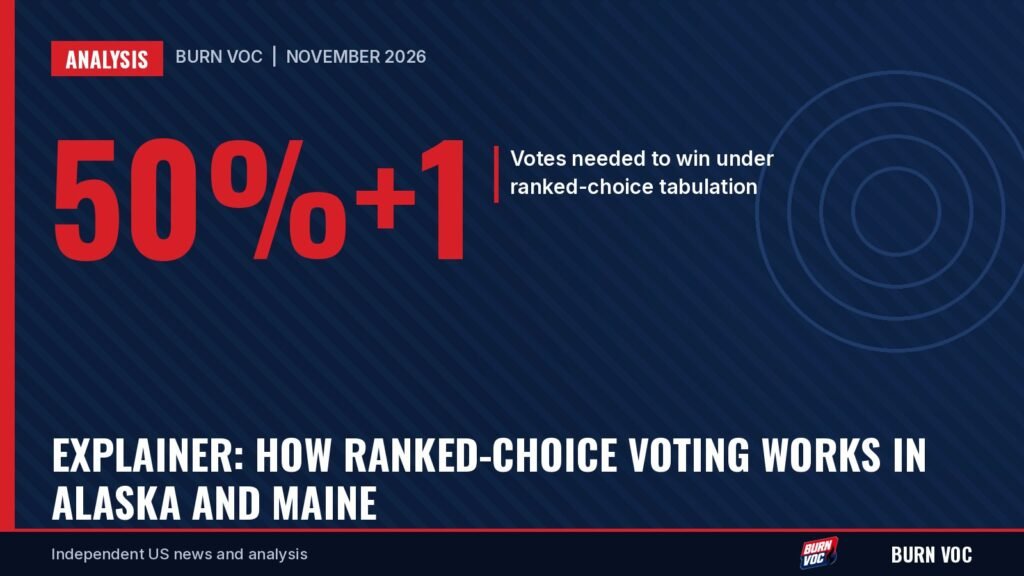
Most American elections are decided by plurality: the candidate with the most votes wins, even without a majority. Alaska and Maine do something different in many races. They use ranked-choice voting.
How the ballot works
Voters rank candidates in order of preference: first choice, second choice and so on. Voters can rank as many or as few candidates as they like.
How the count works
First, election officials count everyone’s first choice. If a candidate wins more than half of those votes, that candidate wins.
If no one has a majority, the candidate with the fewest votes is eliminated. Ballots that ranked that candidate first are then counted for those voters’ next choice. The process repeats until one candidate has a majority of the remaining ballots.
A ballot that does not rank any remaining candidate is considered exhausted and no longer counts in later rounds.
Alaska’s system
Alaska adopted its system by ballot measure in 2020. All candidates appear on a single open primary ballot, and the top four advance to a ranked-choice general election.
This year’s Senate race shows how it can matter. On first-choice votes, former Rep. Mary Peltola narrowly led Sen. Dan Sullivan, with two other candidates sharing about 4 percent. The state plans to run the ranked-choice tabulation on November 18. The second choices of those smaller candidates’ voters could decide the race.
Maine’s system
Maine became the first state to use ranked-choice voting statewide after voters approved it in 2016. It applies to federal primaries and general elections, as well as to state primaries.
The arguments
Supporters say ranked-choice voting ensures winners have majority support, reduces the spoiler effect and encourages less negative campaigns. Critics say it is confusing, slows results and can exhaust ballots of voters who do not rank every candidate.
Several states have banned ranked-choice voting, while some cities, including New York City, use it for local primaries.
What to watch
Alaska’s tabulation will be closely watched by both parties. Because results take time, patience is part of the process. Certification in Alaska is expected around November 25.
How we reported this
This report is based on information confirmed by the Associated Press or by at least two major news organizations, as noted in the text. Claims that have not been independently verified are identified as such. BURN VOC will update this story as new information is released.


