
Iran’s Chief Negotiator Says Americans Voted ‘No to War’
Mohammed Bagher Ghalibaf seized on the midterm results, while Iran's supreme leader said he expects no change in US policy.
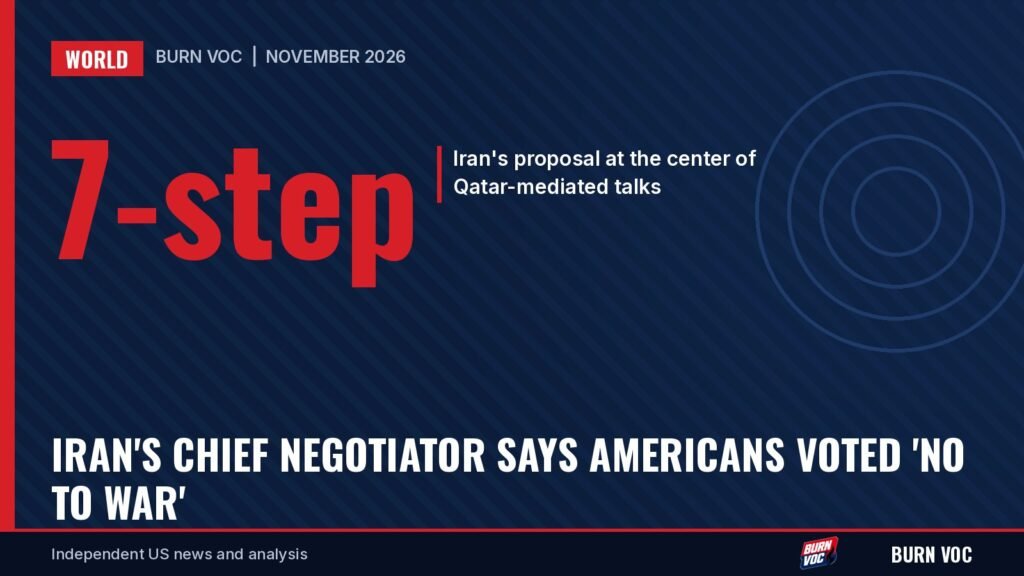
Iran’s chief negotiator in talks with the United States said on Wednesday that American voters had rejected war, after President Donald Trump’s Republican Party suffered heavy losses in the midterm elections.
The message from Tehran
Mohammed Bagher Ghalibaf, the speaker of Iran’s parliament, wrote on X that Americans had said no to war and that Iran endorsed that message, according to the BBC. He also warned that if the US government ignored the public will, Iran’s response would be severe.
Iran’s supreme leader, Mojtaba Khamenei, said in a statement that anyone who expects a change in American hostility toward Iran is gravely mistaken, the BBC reported. He has not been seen in public since the war began.
Trump’s view
Trump acknowledged that the war played a part in the results. “I think a part of it was Iran,” he told Fox News. He has also said he does not regret launching the joint attack with Israel in February, and he told CBS News the conflict would end “when I say it ends.”
The state of talks
Indirect negotiations mediated by Qatar have been stalled for months. Iran’s foreign ministry spokesperson, Esmaeil Baqai, said the talks were still based on a seven-step proposal Iran submitted in September, which had been condensed so it could be carried out within two days, according to the BBC.
Iranian President Masoud Pezeshkian said his government had been trying to resolve the crisis through dialogue and warned that no one would benefit if the war resumed.
Tensions remain high
The diplomatic exchanges came as the Revolutionary Guard made new claims of attacks on shipping in the Strait of Hormuz, which have not been independently verified, and days after limited US strikes on Iran’s Qeshm Island.
Before the election, Trump told the Financial Times that US and Israeli forces were “locked and loaded” if needed, but that there might be no need.
What to watch
The new Democratic Congress, which takes office in January, is expected to press the administration on war powers and costs. Whether that changes the course of talks with Tehran remains an open question.
Developing: some details in this report are preliminary or unconfirmed and are identified as such in the text.
Sources: Associated Press, BBC, CBS News, Fox News, Financial Times.
Get the BURN VOC Briefing
Top US news in your inbox. Free.

This story is published by BURN VOC under its newsroom byline and follows our editorial standards. Sources are named in the story. To report an error, email news@burnvoc.com. Editorial Standards · Corrections · About BURN VOC